Google Ads vs. SEO: Where Should a Small Business Spend First?
“Should I do Google Ads or SEO?” It’s probably the question we get asked most, usually by a business owner with a limited budget who’s been pitched both and wants a straight answer.
The honest answer is that it depends on what you need and when you need it. But “it depends” isn’t very helpful on its own, so this article lays out how each one works, what they really cost, and a simple way to decide where your money should go first.
The short version
If you only read one paragraph, make it this one.
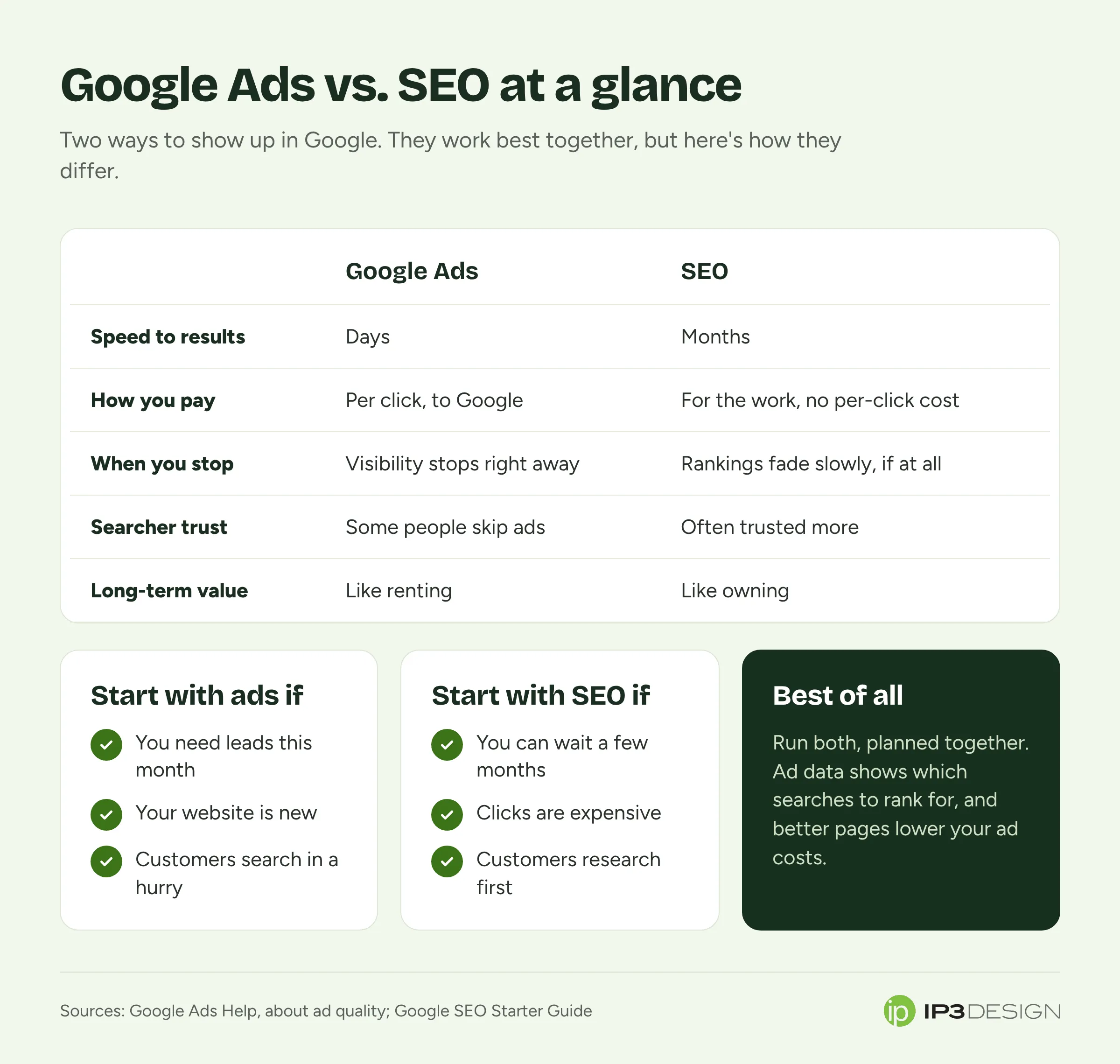
Google Ads puts you at the top of search results quickly, and you pay every time someone clicks. It’s fast, predictable and easy to measure, and it stops the moment you stop paying.
SEO (search engine optimization) earns you a place in the regular, unpaid results. It takes months to build, but once you rank, those visits don’t cost you per click. It’s slower, less predictable, and compounds over time.
Most healthy local businesses end up using both. The question is mostly about order and balance.
How Google Ads works
When someone searches on Google, the sponsored results at the top come from an auction that runs in a fraction of a second. You choose the searches you want to appear for, write your ads, and set how much you’re willing to pay per click.
What surprises a lot of people is that the highest bid doesn’t automatically win. Google’s help page about ad quality explains that the quality of your ads and landing page feeds into where your ad appears, and that higher-quality ads generally lead to better positions and lower costs. Google looks at three things here: how relevant your ad is to the search, how likely people are to click it, and the experience on the page they land on.
That last part is important. If your ad sends people to a slow, generic homepage, you’ll pay more for worse results than a competitor who sends them to a fast page that matches exactly what they searched for. A good chunk of what we do when we take over someone’s ad account isn’t touching the bids at all. It’s fixing the pages the ads point to.
What Google Ads is good at
- Speed. Ads can go live within days and start bringing in calls almost immediately.
- Control. You choose exactly which searches, which areas, which hours and how much you spend.
- Measurement. With proper conversion tracking, you can see which keywords bring calls and form submissions, and what each lead costs.
- Testing. Want to know if people respond to a new service before you build it out? Run ads to it and find out.
- Seasonal pushes. Promotions, holiday rushes and launches where timing matters.
Where Google Ads falls short
- It stops when you stop. The day your budget runs out, your visibility disappears.
- Costs can climb. In competitive industries like legal, home services and healthcare, clicks can be expensive, and prices tend to rise as more competitors bid.
- Some people skip ads. Plenty of searchers scroll straight past the sponsored results.
- Easy to waste money. Badly set up campaigns show for irrelevant searches and burn budget quietly. We’ve seen accounts spending real money on searches that have nothing to do with the business.
How SEO works
SEO is the work of making your website the best answer to the searches your customers make, and making sure Google can find and understand it. Google’s own SEO Starter Guide is a good plain-English introduction to the basics if you want to go to the source.
In practice, SEO for a small business usually means:
- Technical health: a fast, mobile-friendly site that search engines can crawl and index without problems.
- Relevant content: clear service pages that explain what you do, where, and for whom, plus articles that answer real customer questions.
- Local presence: a well-maintained Google Business Profile and consistent listings, if you serve a local area.
- Reputation: reviews, mentions and links from other reputable websites that show you’re a real, trusted business.
What SEO is good at
- It compounds. A page that ranks well can bring in visitors month after month without a per-click cost.
- Trust. Many people trust organic results more than ads, especially for bigger decisions.
- Broader reach. Good content can rank for hundreds of related searches you’d never think to bid on.
- It’s an asset. The content and reputation you build belong to your business. They don’t vanish when a budget ends.
Where SEO falls short
- It’s slow. Expect months, not weeks, before meaningful results on competitive searches.
- It’s less predictable. Google updates its systems regularly, and rankings move.
- It takes ongoing effort. It’s not a one-time project, and competitors are working on it too.
- Results are harder to tie to dollars, at least at first, compared with the clean numbers from ads.
What each one really costs
This is where the comparison usually goes wrong, so it’s worth spelling out.
With Google Ads, there are two costs: the clicks themselves, which go to Google, and the management, whether that’s your time or an agency’s fee. Click costs vary enormously by industry and location. A click for an emergency service in a big city might cost many times more than a click for a niche product. The useful number isn’t cost per click, though. It’s cost per customer. A $20 click that turns into a $2,000 job is a bargain; a $2 click that never converts is a waste.
With SEO, you’re paying for work rather than clicks: improving your site, writing content, building your local presence. It’s an investment that takes a while to show a return, but the return keeps coming after the work is done.
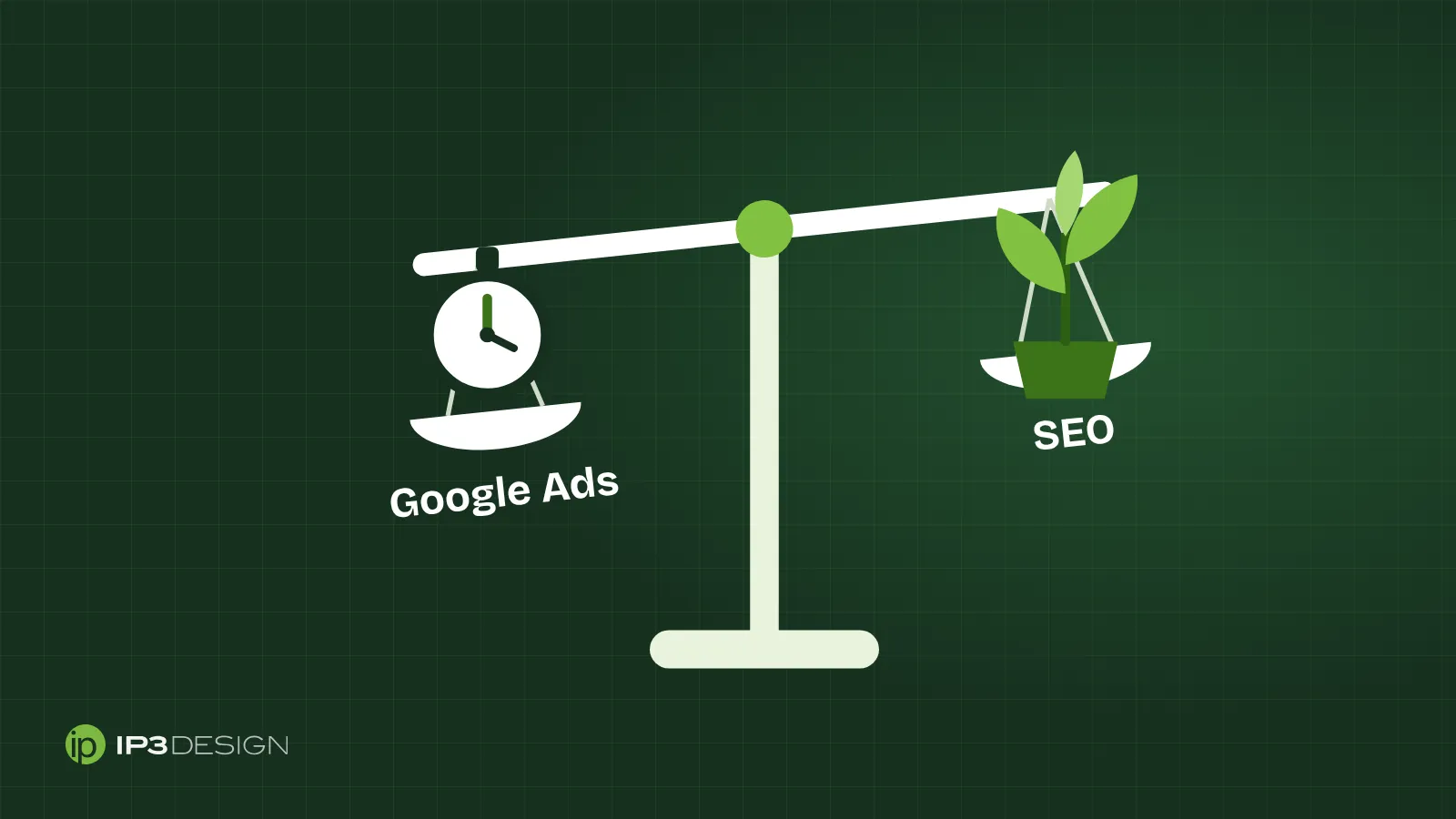
A rough way to think about it: ads are like renting a billboard on the busiest road in town, and SEO is like buying the building. Renting gets you seen today. Owning takes longer and costs more up front, but you’re building equity.
How to decide where to start
Here’s the framework we use with clients. Answer these honestly.
Start with Google Ads if…
- You need leads this month. A new business, a slow season or a cash-flow crunch doesn’t leave time for SEO to kick in.
- Your website is new and has no search history yet. New sites take time to earn rankings.
- You’re testing a new service or area and want quick feedback on demand.
- Your customers search with urgent intent, like “emergency plumber” or “locksmith near me.” People in a hurry often click the first thing they see.
Start with SEO if…
- You can be patient for a few months and want to build something that lasts.
- Your clicks would be very expensive in your industry, so organic traffic offers big long-term savings.
- Your customers research before buying, reading reviews, comparing options and reading articles. Content helps you win that research phase.
- You already have a website with some history that just needs improving.
Do both, in proportion, if…
You can. This is where most businesses land after the first few months, and it’s usually the most efficient approach, because the two help each other:
- Ads tell you what works for SEO. Your ad data shows which searches actually produce customers. Those are the keywords worth the long effort of ranking organically.
- SEO makes ads cheaper. The same improvements that help you rank, like fast, relevant landing pages, also improve your ad quality, which tends to lower your costs.
- Appearing twice builds trust. Showing up in both the ads and the organic results for the same search makes you look like the established choice.
- You can shift spend over time. As organic rankings grow for certain searches, you can often reduce ad spend on those and redirect it elsewhere.
A typical plan for a local business
To make this concrete, here’s how we’d often structure the first year for a local service business with a modest budget:
- Months 1–3: Fix the website basics, especially speed, mobile usability and clear service pages, and set up conversion tracking. Launch a tightly focused Google Ads campaign on high-intent searches in your service area. Optimize your Google Business Profile.
- Months 3–6: Use ad data to see which services and searches bring the best customers. Build out content and service pages around those. Start a steady rhythm of reviews.
- Months 6–12: As organic rankings and map visibility grow, rebalance. Keep ads running for the most valuable or competitive searches, and lean on SEO for the rest.
Every business is different, but that rhythm of getting leads coming now while building something durable in the background works for a lot of them.
Mistakes we see all the time
- Running ads to the homepage. Send people to a page that matches their search.
- No conversion tracking. If you can’t see which clicks become customers, you’re guessing.
- Letting Google’s default settings run wild. Broad targeting with no exclusions can show your ads for all sorts of irrelevant searches.
- Expecting SEO results in a month, then giving up just before it starts working.
- Buying cheap “SEO packages” that promise page-one rankings for a flat fee. Nobody can guarantee rankings, and the shortcuts these packages use often do more harm than good.
- Treating them as rivals. They’re two tools for the same job.
How to tell if it’s working
Whichever you choose, decide up front how you’ll judge it. Otherwise you’ll end up arguing about feelings instead of numbers.
For Google Ads
- Cost per lead: total ad spend divided by the number of calls and form submissions the ads produced. This is the number to watch.
- Lead quality: are the calls from people who want what you sell, in the area you serve? Ask your front desk. Ten great leads beat fifty bad ones.
- Search terms report: the actual searches that triggered your ads. Review it regularly and exclude anything irrelevant.
- Conversion tracking that counts calls, not just form submissions. For many local businesses, most leads come by phone.
For SEO
- Rankings for the searches that matter, especially in the map results for your area. Track a short list of important searches, not hundreds.
- Organic traffic to service pages, not just the homepage or blog.
- Leads from organic search: calls, forms and bookings from people who found you without an ad.
- Business Profile activity: calls, direction requests and website clicks.
Give ads a few weeks of data before making big judgments. Give SEO a few months. And look at both together, because the two channels influence each other.
Questions we hear a lot
Can I just do SEO myself?
Some of it, absolutely. Keeping your Business Profile current, asking for reviews and writing helpful pages about your services are things any business owner can do well. The technical side, like site speed, indexing problems and redirects, usually benefits from someone who does it every day.
How much should I budget?
There’s no universal number, because it depends on your industry, your area and how many new customers you need. A better way to start is backwards: figure out what a new customer is worth to you, how many you want each month, and what you could afford to spend to win one. That tells you what a sensible budget looks like, and it’s the conversation we have in every free consultation.
What if a competitor clicks my ads to waste my budget?
Google has systems that filter out many invalid clicks, and you aren’t charged for clicks it identifies as invalid. If you see suspicious patterns, like lots of clicks with no leads from one area, it’s worth investigating and adjusting your targeting.
The bottom line
If you need customers now, start with ads, set up properly. If you can play a longer game, invest in SEO. And as soon as you can, do both, because each one makes the other more effective.
We manage both under one roof, which means your ads and your organic strategy are planned together instead of competing for budget. Learn more about our Google Ads management and SEO services, or book a free consultation and we’ll look at your market and tell you where we’d put the first dollar.