How Google's AI Search Is Changing SEO for Small Businesses
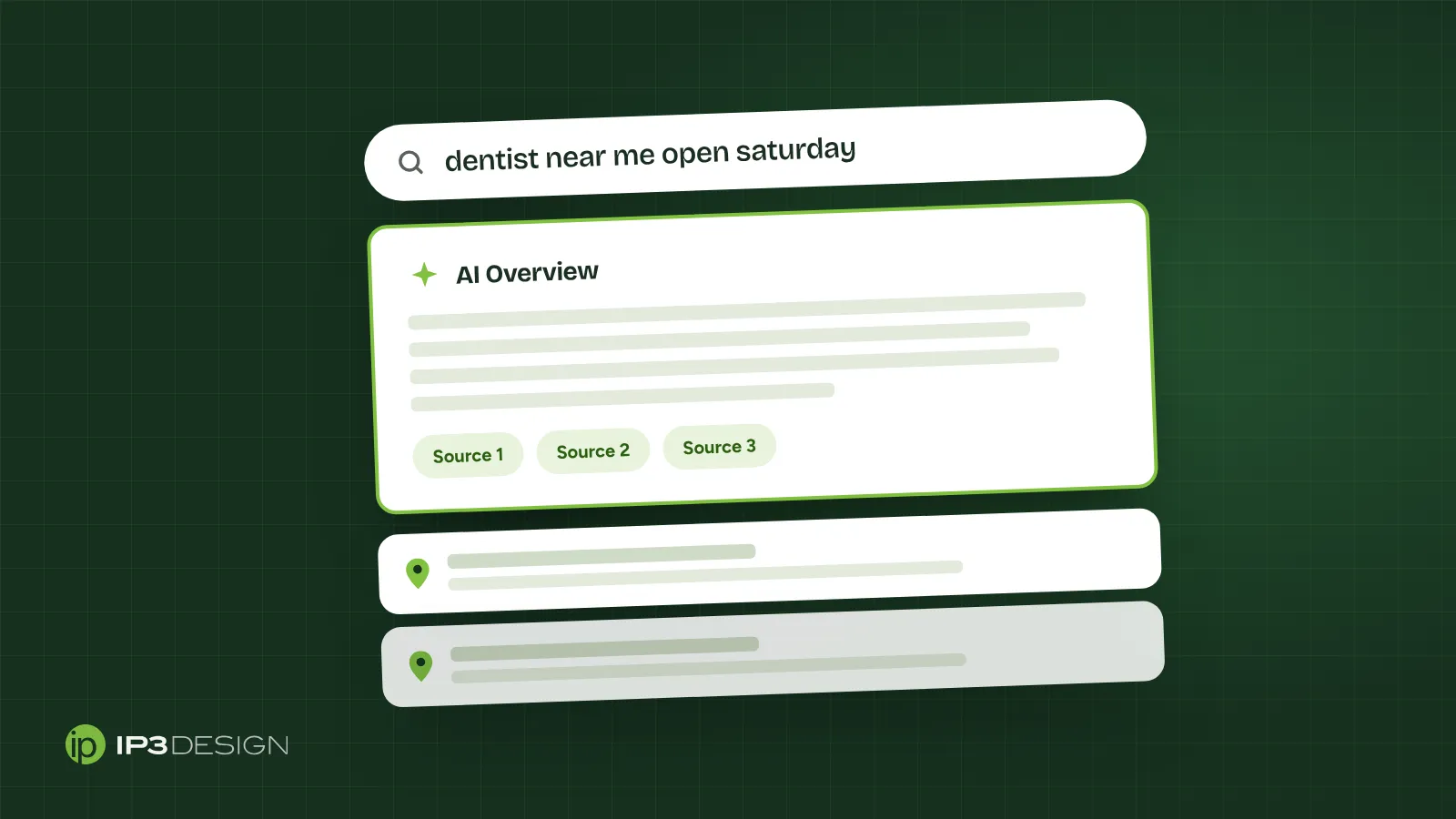
Try searching for your own service in Google, the way your customers would. There’s a good chance the first thing on the screen isn’t your website or your competitor’s. It’s a paragraph written by Google’s AI, summarizing an answer and citing a handful of sources underneath. If that made your stomach drop a little, you’re not alone. “Is SEO dead now?” is one of the most common questions business owners are asking.
It isn’t. But it has changed, and some of the advice floating around about it is nonsense. So here’s what’s going on, what Google itself says about it, and what we’re actually telling our clients to do.
What changed in Google search
For most of Google’s history, a search returned ten blue links, some ads and, for local searches, a map with a few businesses. You clicked a link, landed on a website, and got your answer there.
Now, for a lot of searches, Google answers first. There are two main versions of this:
- AI Overviews appear at the top of regular search results. They’re a short, generated summary with links to the pages Google drew on.
- AI Mode is a separate, conversational search experience. You ask a question, get a longer answer, and can ask follow-ups, a bit like chatting with an assistant.
Both pull their information from the same web pages Google has always indexed. That point matters more than anything else in this article, so hold onto it.
Why business owners are worried
The worry is simple. If Google answers the question on the results page, fewer people click through to websites. For some kinds of searches, especially quick factual ones like “what time does the DMV close” or “how many ounces in a cup,” that’s clearly true. People get the answer and leave.
But think about what your customers are actually searching for. Someone looking for a dentist in Glendale, a roofer in Burbank or a web designer in Pasadena isn’t trying to learn a fact. They’re trying to find a business to hire. An AI summary can help them narrow the field, but at some point they still need to look at a website, check reviews, see photos and pick up the phone.
What’s changed is where you get filtered. Before, you competed to be one of the ten links. Now you also compete to be one of the few sources the AI summary mentions, and to look like the obvious choice when someone does click.
What Google actually says about ranking in AI search
There’s a cottage industry of consultants selling “AI optimization,” “GEO” and “AEO” packages right now. Before you buy any of it, read what Google has published, because it’s surprisingly direct.
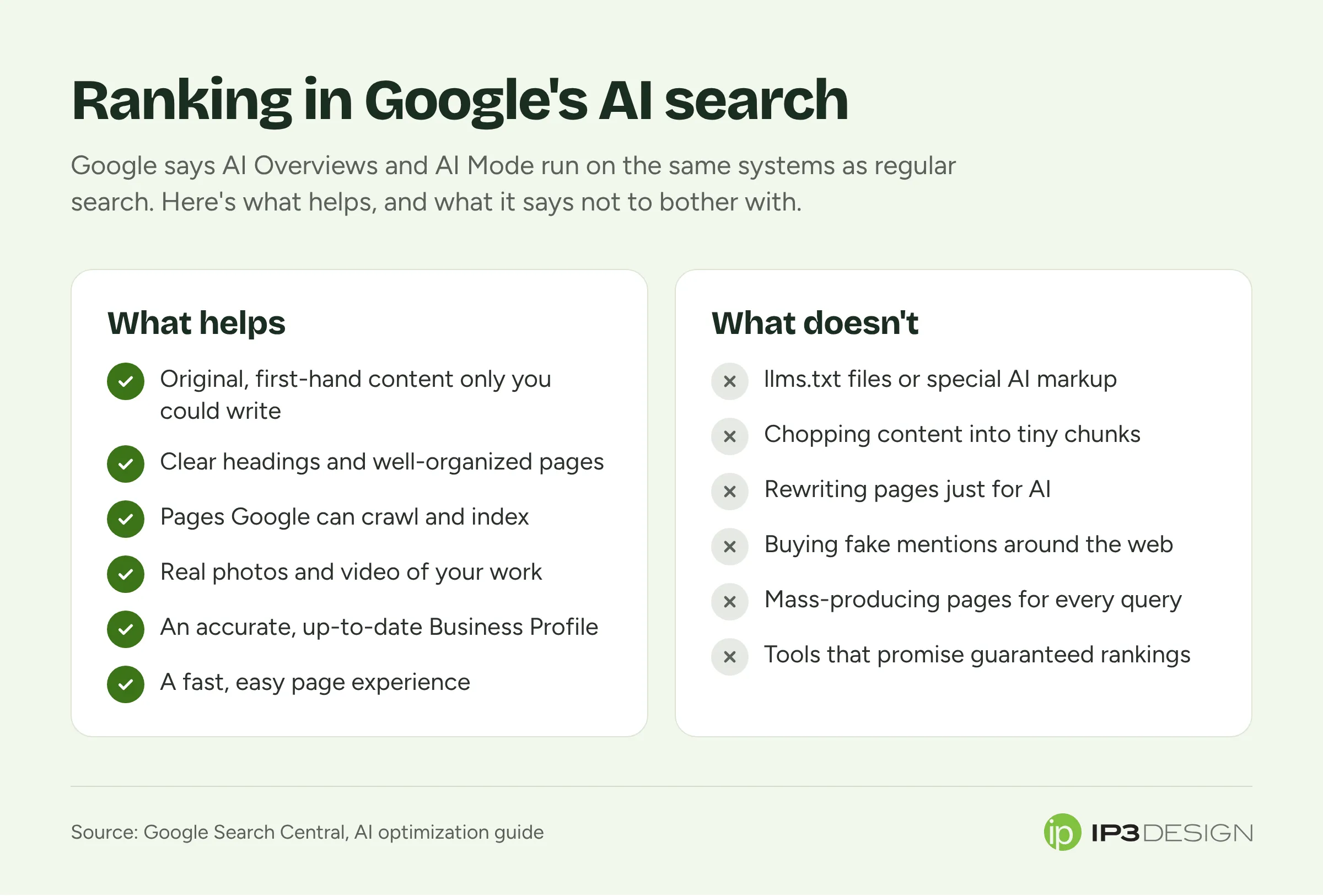
In its guide to optimizing for generative AI features, Google says the AI features are built on the same core ranking and quality systems as regular search, and that optimizing for them is still SEO. Its separate page on AI features and your website says there are no additional technical requirements and no special optimizations needed. If your page is indexed and eligible to show in search with a snippet, it’s eligible to appear as a link in AI Overviews and AI Mode.
Google also lists things it says not to do, and a few of them are exactly what some vendors are selling:
- Don’t create special “AI files” or markup for Search. Google says Search doesn’t use llms.txt files or special schema for AI features.
- Don’t chop your content into tiny chunks to feed the AI. There’s no ideal page length. Write for your readers.
- Don’t rewrite your pages specifically for AI systems. Google’s systems already understand synonyms and meaning.
- Don’t chase fake “mentions” around the web to look popular. Google’s spam systems are built to ignore that.
- Don’t churn out dozens of near-identical pages for every variation of a question. Google treats that as scaled content abuse, which can get your site penalized.
- Be skeptical of tools that promise rankings or claim access to Google’s internal metrics. Google says no third-party tool has that access.
If someone pitches you a package built around any of those, you now know what Google thinks of it.
What actually helps your business show up
So if there’s no secret trick, what moves the needle? Mostly the fundamentals, done well. Here’s what we focus on.
Write things only you could write
Google’s guide puts this first, and we agree. It calls it “non-commodity” content: a unique, first-hand or expert view rather than a rewrite of what’s already out there.
This is good news for small businesses, because you have something the big content farms don’t. You’ve done the work. A plumber who’s fixed a thousand slab leaks in the San Fernando Valley knows things no generic article does: which neighborhoods have older pipes, what a repair actually involves, what it typically costs and why. That kind of detail is exactly what an AI summary wants to cite, and exactly what a customer wants to read before they call.
So when you write a service page or blog post, ask yourself: what do we know from experience that a competitor’s copywriter wouldn’t? Put that in. Real examples, real processes, honest answers to the questions customers ask you on the phone.
Organize pages so they’re easy to scan
This one’s simple. Use clear headings that describe what each section covers. Keep paragraphs focused. Answer the question the page is about early, then go deeper.
You’re not doing this for the robots specifically. You’re doing it because people skim, and pages that are easy for people to skim also happen to be easy for search engines to understand. A service page with headings like “What’s included,” “How long it takes” and “What it costs” will serve both.
Make sure Google can actually read your site
None of the good content matters if Google can’t crawl and index it. This is where a lot of small business websites quietly fail. Common problems we find:
- Important text that only exists inside images, so search engines can’t read it
- Pages accidentally blocked from search engines, often left over from a site’s development phase
- Content that only loads after complicated JavaScript runs
- Slow, bloated pages that frustrate visitors on phones
A good place to start checking is Google Search Console, a free tool that shows which of your pages are indexed and how they perform in search. Traffic from AI Overviews and AI Mode shows up in its Performance report, so you can see whether your visibility is growing.
Keep your Google Business Profile current
For local businesses, this might be the single most valuable thing you can do. Google’s own guide calls out Business Profile as a way for local businesses to appear in AI responses. When someone asks AI Mode for “a family dentist near Glendale that’s open Saturdays,” Google needs accurate, current information to answer, and your Business Profile is where a lot of it comes from.
That means correct hours (including holiday hours), the right categories, real photos, a description that says what you actually do, and a steady stream of genuine reviews with thoughtful replies. Our local SEO service is built around exactly this, because it’s where nearby customers decide.
Use real images and video
Google’s guide also mentions images and video. Not stock photos of smiling people in headsets, but real pictures of your work, your team and your location. They help your pages stand out in search, and they give customers a reason to trust you over the business down the street with the generic template site.
Earn trust the slow way
Reviews, local press, links from your chamber of commerce, being listed accurately in directories, sponsoring the Little League team and getting a mention on their site. None of this is new, and none of it is fast. But it’s what makes a business look established to both people and search engines, and it can’t be faked at scale.
What this means for your website traffic
We’ll be honest: some websites will see fewer clicks for some searches. If your site gets a lot of traffic from quick informational questions, an AI summary may answer them without a click.
But for most small businesses, the visits that matter weren’t those anyway. The visits that matter are from people ready to hire someone. And those people still click through, because they need to make a decision, and they want to see who they’re dealing with.
So instead of counting raw visits, pay closer attention to:
- Calls, form submissions and booking requests from search
- Which pages people land on before they contact you
- What searches bring people in, which Search Console will show you
- How your Business Profile performs: calls, direction requests and website clicks
If those numbers are healthy, a dip in total traffic from quick-answer searches isn’t something to lose sleep over.
Should you still run Google Ads?
AI search hasn’t replaced ads. Sponsored results still appear, and for businesses that need leads this week, paid search is still the fastest way to get in front of people actively looking. We usually recommend ads and SEO together. Ads bring in customers while your organic visibility builds, and the data from your ads shows which searches are worth targeting long term.
A simple plan for the next 90 days
If you want something practical to do, here’s the order we’d tackle things in for a typical local business:
- Check your Business Profile. Confirm your hours, categories, phone number, website link and description are right. Add a dozen real photos. Reply to every review from the last few months.
- Set up Search Console if you haven’t, and look at which pages are indexed. Fix anything important that isn’t.
- Rewrite your main service pages with real detail: what you do, how it works, how long it takes, what affects the price, and answers to the questions customers actually ask you.
- Check your site on your phone. If it’s slow, hard to read or awkward to contact you from, fix that before anything else. Mobile visitors who bounce don’t come back.
- Write one genuinely useful article a month about something you know well. One good piece beats ten thin ones.
- Ask happy customers for reviews, every time. Make it easy with a direct link.
None of this is glamorous. That’s sort of the point. The businesses that do well in AI search are, for the most part, the ones that were already doing the basics properly.
Questions we get asked about AI search
Can I stop Google from using my content in AI Overviews?
You can limit it, but think hard before you do. Google’s documentation says the same controls that limit regular search snippets, like the nosnippet and max-snippet settings, also limit what appears in AI features. There’s also a separate setting, Google-Extended, that controls whether your content is used to train and ground some of Google’s other AI systems, but it doesn’t affect Search.
For almost every small business, we’d recommend leaving things open. Blocking snippets makes your listing less useful in regular search too, and you’d be removing yourself from answers your customers are reading.
Do I need to worry about ChatGPT and other AI assistants too?
People are using a growing mix of AI tools to research purchases, and those tools draw on the public web in their own ways. The encouraging part is that what helps you in Google mostly helps everywhere: clear, detailed, accurate information about your business, consistent listings across the web, and a good reputation. There’s no reliable shortcut for any of them, whatever the sales pitches say.
Should I use AI to write my website content?
You can use it as a tool, but don’t let it do the thinking. Google’s guidance cares about whether content is helpful and original, not whether a person or a program typed it. The problem with AI-written pages is that they tend to say what every other page already says, which is exactly the “commodity” content Google says to avoid. Use AI to help outline or tidy up, and then add what only you know: your examples, your process, your opinions, your prices.
How do I know if AI search is affecting my traffic?
Search Console includes visits from AI Overviews and AI Mode in its Performance report, so look at your clicks and impressions over time. Then look at what really counts: are calls, form submissions and bookings holding steady or growing? If leads are healthy, a shift in how people find you isn’t a problem.
Where we come in
We’ve been building websites and doing SEO since 1995, which means we’ve watched a lot of “SEO is dead” moments come and go. Every one of them ended the same way: the businesses that focused on being genuinely useful to their customers kept winning.
If you’d like a second set of eyes on how your site and Business Profile are positioned for AI search, our SEO services start with a free review. Get in touch and we’ll tell you honestly what we’d fix first.