Law Firm SEO: How Attorneys Get Found on Google Without Breaking the Rules
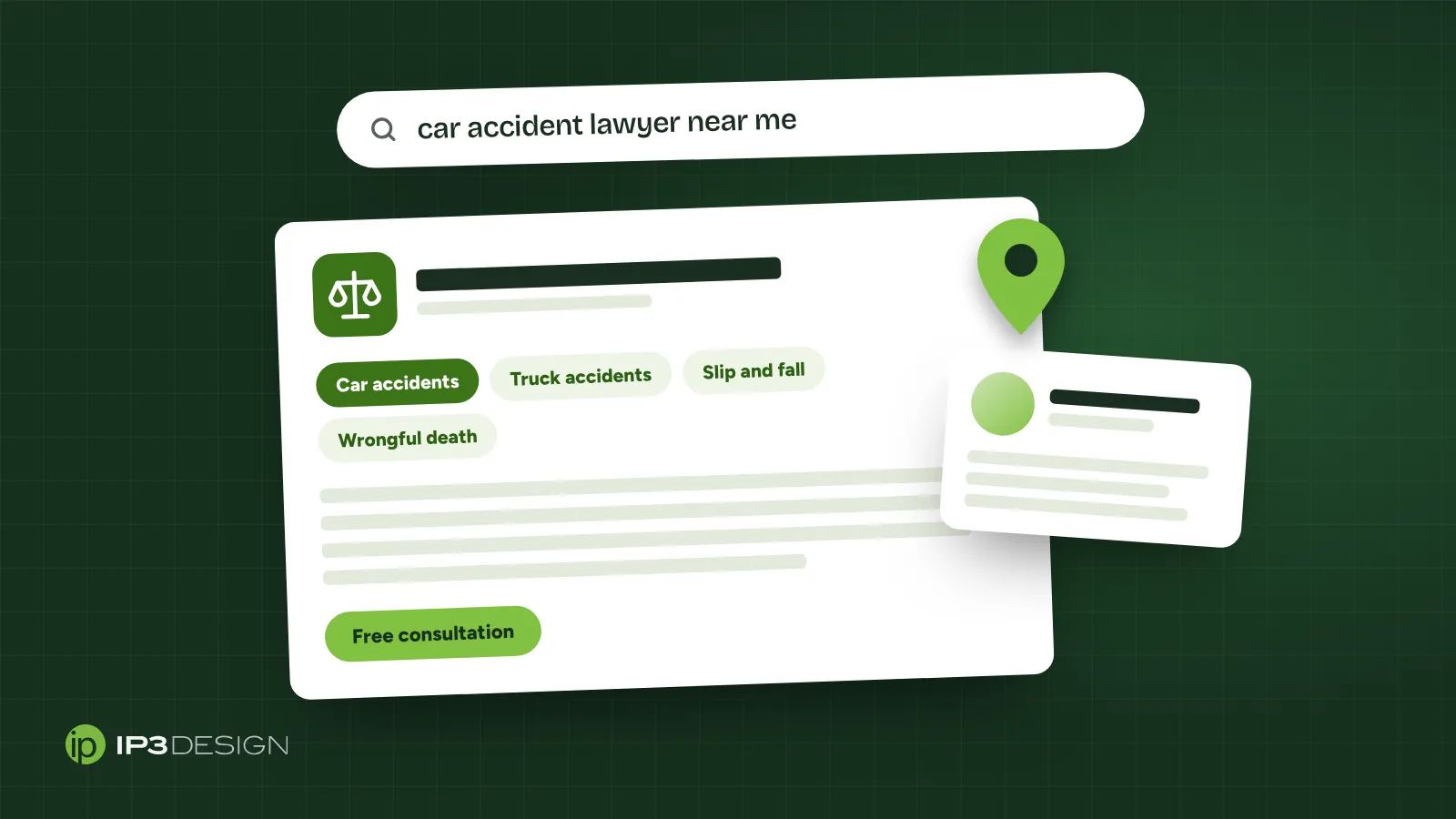
Picture someone sitting in their car on the shoulder of the 134 after a collision. The other driver’s insurance company has already called. They open their phone and type “car accident lawyer Glendale.” Within a minute or two they’ve looked at the map results, opened two or three websites, and called the firm that seemed to understand their situation.
That minute is where most law firms win or lose new clients. Referrals still matter, but even referred clients look you up before they call. What they find on Google, and how quickly it reassures them, shapes whether the phone rings.
Search engine optimization for a law firm is the work of making sure you show up in that moment, for the cases you actually want, with a website that earns the call. It’s also work that has to stay inside the rules that govern how lawyers advertise. Here’s how we approach it.
Why law firm SEO is different
Every local business competes in search, but law firms face a few challenges most don’t.
The stakes are high for the client. People hiring a lawyer are often stressed, sometimes frightened, and making a decision that matters a great deal. They read carefully. Thin, generic pages don’t convince them.
Competition is intense. In a market like Los Angeles, popular practice areas have many established firms competing for the same searches, and some of them have been investing in SEO for years.
Advertising rules apply to your website. In California, your website is a communication about your services, and the State Bar’s rules apply to it the same way they apply to a billboard or a TV spot.
Confidentiality limits what you can say. Many businesses build trust with detailed case studies and public replies to reviews. Lawyers have to be far more careful.
None of this makes SEO harder to do well. It just means the shortcuts other businesses take aren’t available to you, and the firms that do the fundamentals properly tend to pull ahead.
Start with the rules
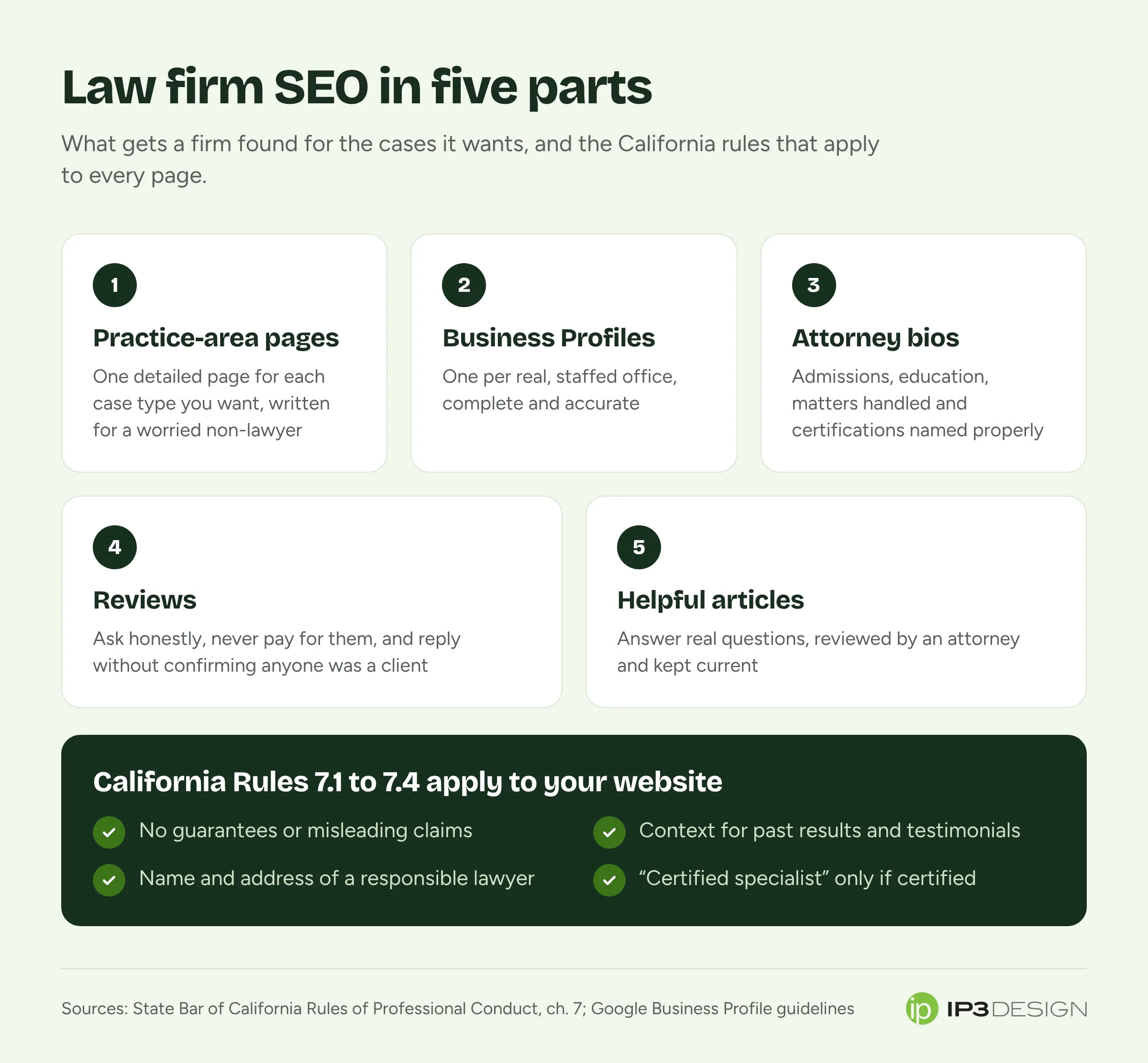
Before writing a word of new content, it helps to know the lines you’re working within. California’s Rules of Professional Conduct, Chapter 7 covers communications about a lawyer’s services. A few points come up constantly on law firm websites:
- Rule 7.1 prohibits false or misleading communications, including statements that are technically true but create unjustified expectations. Its comments say an express guarantee of a particular result is misleading.
- The comments to Rule 7.1 also note that past results and testimonials can mislead if they suggest a new client will get the same outcome, and that appropriate disclaimers or qualifying language often help.
- Rule 7.2 requires every advertising communication to include the name and address of at least one lawyer or law firm responsible for its content.
- Rule 7.4 lets you describe the fields you practice in, but you can only claim to be a certified specialist if you’re currently certified by the State Bar’s Board of Legal Specialization or another accredited body, and you name the certifying organization.
In practice, that rules out a lot of familiar website copy: “We always win,” “LA’s top-rated injury lawyer,” “the best criminal defense in Pasadena.” Specific, factual descriptions of what you do, how you do it and who does it are both compliant and more persuasive to a careful reader. When in doubt, run it past your ethics counsel. We cover the rest of the rules on our attorney marketing page.
Build a page for every practice area that matters
This is the single most important piece of law firm SEO, and the one most firms underinvest in.
A “Practice Areas” page that lists twelve services in a paragraph each won’t rank for any of them. Someone searching “Pasadena estate planning attorney” or “Burbank wrongful termination lawyer” wants a page about exactly that. Google wants to show them one.
What a strong practice-area page includes
Each page should answer the questions a prospective client has before they call:
- What the practice area covers, in plain language rather than statutory terms
- Common situations you handle, so readers recognize their own problem
- How the process usually works, from first consultation to resolution
- What affects the timeline, without promising one
- How fees work at your firm, for example contingency, flat fee or hourly, described accurately
- What to bring to a consultation
- Who at the firm handles these matters, linked to their bios
- A clear way to get in touch, visible on a phone without scrolling forever
Go deeper where the cases are
If personal injury is your core practice, one personal injury page isn’t enough. Car accidents, truck accidents, motorcycle accidents, slip and falls and dog bites are different searches with different questions behind them. The same goes for family law (divorce, custody, support), employment law (wrongful termination, wage claims, discrimination) and criminal defense (DUI, drug charges, domestic violence).
Build pages for the case types you most want, in the order they matter to your business. Don’t create pages for work you don’t actually do. They attract the wrong calls and dilute the pages that count.
Write for the reader, then review for the rules
Write each page for a worried non-lawyer who’s reading on a phone. Short paragraphs, clear headings, no jargon without explanation. Then have an attorney review it for accuracy and for the Chapter 7 rules above. Google puts extra weight on expertise for topics like legal matters, and a page that clearly reflects a practicing lawyer’s knowledge is exactly what it’s looking for.
Get your Google Business Profiles right
For most local searches, the map results appear before the regular results, and they drive a large share of calls to law firms. Your Google Business Profile is what appears there.
One profile per real, staffed office
Google’s guidelines for representing your business are strict about addresses. A business must be reachable in person at the verified location during its stated hours. A rented mailing address the business doesn’t operate from isn’t eligible, and neither are remote mailboxes. Offices in coworking spaces only qualify with clear signage and staff during business hours.
This matters for law firms more than most, because “satellite offices” in executive suites are common. If attorneys don’t actually meet clients there during stated hours, a profile at that address risks suspension, and a suspended profile can take weeks to restore.
Attorneys can have their own profiles
The same guidelines allow individual practitioners, including lawyers, to have their own profiles if they’re public-facing. Support staff shouldn’t, and a practitioner shouldn’t have multiple profiles for different specialties. For a solo practitioner operating under a firm brand, Google suggests sharing the firm’s profile using the format “[firm name]: [attorney name].”
Whether individual profiles make sense depends on your firm. They can help when clients search for attorneys by name, but they need the same care as the firm’s profile.
Fill in everything
Choose the most specific primary category that fits (“Personal injury attorney” rather than “Lawyer” if that’s your focus), keep hours accurate, add real photos of your office and team, write a description of what you actually handle, and list your services. Our local SEO service covers the full setup.
Attorney bios that build trust
For a decision this personal, people want to know who they’ll be working with. Attorney bios are often among the most visited pages on a law firm website, and they’re frequently neglected.
A strong bio includes bar admissions, education, the kinds of matters the attorney handles, any State Bar specialization certification (named properly), languages spoken, and a recent professional photo. A few sentences about why they practice in this area helps readers connect. Keep any description of past results accurate and in context.
Bios also help search engines understand who stands behind your content. When your practice-area pages link to the attorneys who handle that work, both readers and Google can see the expertise behind the advice.
Reviews: important, and full of pitfalls
Reviews influence both where you appear in the map results and whether people call. They’re also an area where law firms need extra care.
Getting reviews honestly
Ask satisfied clients for reviews, at a natural point such as the close of a matter. Make it easy with a direct link. Don’t offer anything in exchange for a positive review, don’t write reviews yourself or have staff do it without disclosure, and don’t post reviews from friends who were never clients. The FTC’s rule on consumer reviews and testimonials prohibits fake reviews and reviews bought on the condition they’re positive, and it allows civil penalties for knowing violations.
Remember that some clients won’t want their legal matter associated with their name in public, and that’s their call. Never pressure anyone.
Replying without breaching confidentiality
Replying to reviews is good practice, but your duty of confidentiality applies. Never confirm someone was a client, mention their matter, or respond to criticism with details of the case. A short, gracious reply to positive reviews and a calm, general reply to negative ones (“We take all feedback seriously; please contact our office so we can discuss your concerns”) is the safe approach.
Helpful articles that answer real questions
People search their legal questions long before they search for a lawyer. “What happens at a DUI arraignment in California?” “How is child support calculated?” “Can my employer fire me for taking medical leave?” Clear, accurate articles answering these questions bring people to your site early, and many of them come back when they’re ready to hire.
A few principles keep this content effective and safe:
- Answer the question directly, then add the nuance
- Explain general information, not legal advice, and say so where appropriate
- Have an attorney review every article, and consider naming the reviewer on the page
- Keep articles current, since laws and procedures change
- Link each article to the related practice-area page, so readers can take the next step
One well-researched article a month beats a dozen thin ones. Search engines have become very good at telling the difference.
Links: earned, not bought
Links from other reputable websites still help search engines judge which firms are established. The trouble is that buying links, or joining schemes that trade them, is exactly the kind of manipulation Google penalizes. We covered why in Why Just Building Links Doesn’t Work Anymore.
Law firms have plenty of legitimate ways to earn links: bar association and community organization memberships, speaking at local events, writing for legal publications, sponsoring local causes, and being quoted as a source by journalists. These take longer than buying links, but they don’t put your site at risk.
The technical basics still matter
All of this rests on a website that search engines can crawl and visitors can use. For law firms, the most common problems we see are slow pages loaded with heavy video backgrounds and plugins, practice-area content hidden in tabs or images, phone numbers that aren’t tappable on mobile, and old pages left online with outdated information.
Fix the basics before investing heavily in content. A fast, simple, accessible site makes every other part of SEO work better. Our SEO service starts with exactly this kind of review.
Measure cases, not rankings
Rankings are a means, not the goal. What matters is whether search brings in consultations for the kinds of cases you want. Track:
- Calls and form submissions from organic search, broken down by landing page
- Which practice-area pages bring inquiries, so you know where to invest next
- Google Business Profile activity: calls, website clicks and direction requests
- Consultations and signed matters, which your intake team should record by source
If you can connect signed cases back to the page that brought the client in, you’ll know exactly which parts of your SEO pay for themselves.
A 90-day plan for a law firm
If you want to start now, here’s a sensible order:
- Audit your website for Chapter 7 issues. Remove guarantees and unsupported superlatives, check specialist claims and add any missing required information.
- Fix your Google Business Profiles. One per real, staffed office, complete and accurate.
- Rewrite your top three practice-area pages using the structure above.
- Update attorney bios with credentials, photos and links to the practice areas each attorney handles.
- Start a simple review routine at the close of each matter, with safe reply templates.
- Publish one attorney-reviewed article a month answering a question prospective clients ask often.
- Set up tracking so you can see which pages and searches lead to consultations.
Common questions
How long does law firm SEO take?
For competitive practice areas in a market like Los Angeles, expect several months of consistent work before significant gains, and longer for the most competitive searches. Map results for a well-optimized office can improve sooner.
Should every attorney have their own Google Business Profile?
Not necessarily. Google allows it for public-facing practitioners, but each profile needs to be accurate and maintained. For many small firms, a single strong firm profile is the better place to start.
Can we list case results on our website?
Many firms do. Present them accurately, with context and appropriate qualifying language, and have your ethics counsel review the page before it goes live.
Where we come in
We build SEO programs for law firms that bring in the cases they want, written within California’s advertising rules and focused on measurable results. Many of our legal clients are in professional districts like Century City, where competition for every search is intense. Learn more about our attorney marketing work, or book a free consultation and we’ll review your firm’s website and Google presence.