SMS Marketing Rules for Small Businesses: Consent, Opt-Outs and Registration
Text messages get read. Most people glance at a new text within minutes, which is exactly why businesses want to send them and exactly why the rules around marketing texts are stricter than the rules around email.
Say you own a boutique in South Pasadena and you’ve collected a few hundred phone numbers at the register over the years. A weekend sale is coming up, and a quick text to everyone seems like the easiest promotion you’ll ever run. Before you send it, it’s worth knowing that federal rules on marketing texts carry real penalties, that the phone carriers have their own requirements, and that “they gave us their number” usually isn’t the same as permission to text them offers.
None of this should scare you off. SMS can be one of the most effective channels a small business has. It just needs to be set up properly from the start. Here’s what that involves, in plain English. This isn’t legal advice, and if your situation is unusual, a short conversation with an attorney who handles telemarketing law is money well spent.
Two sets of rules, not one
When you send marketing texts in the United States, two separate systems apply.
Federal law. The Telephone Consumer Protection Act (TCPA) and the FCC’s rules under it govern calls and texts, including marketing messages. These rules are enforced by regulators and through private lawsuits, and the law sets damages per message, which is why a single careless campaign to a large list can become expensive.
Carrier requirements. The mobile carriers and the wider messaging industry set standards for business texting, largely through the CTIA’s messaging principles. These aren’t laws, but carriers can filter or block messages that don’t follow them, and your texting platform will require you to comply.
Following both is what keeps your texts legal and delivered.
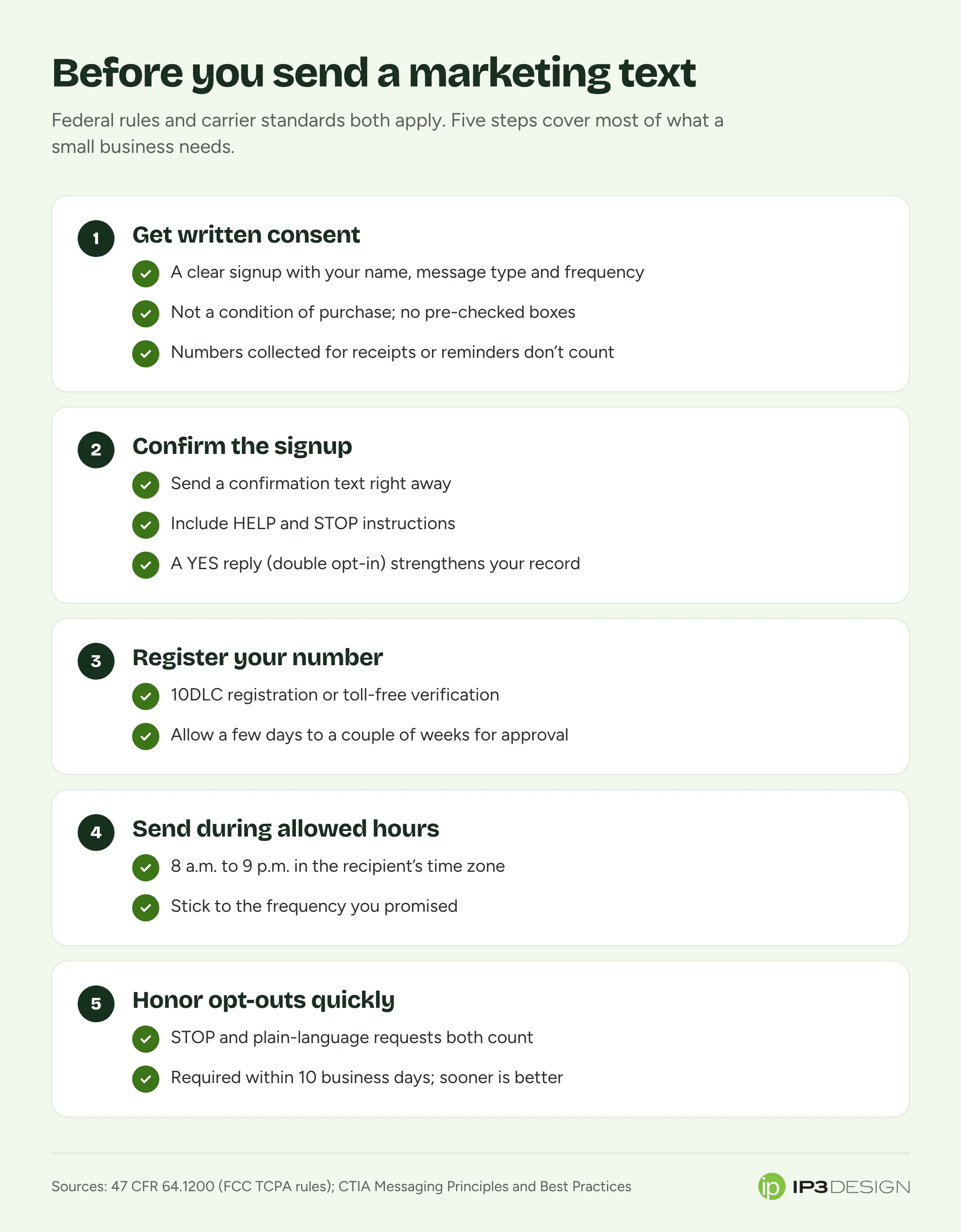
Consent is the foundation
Almost every SMS problem traces back to consent.
What counts as consent
For marketing texts sent with the kind of automated platforms businesses use, the FCC’s rules at 47 CFR 64.1200 require “prior express written consent.” That means a written agreement, which can be electronic, such as a checkbox on a web form or a text-to-join keyword, that:
- Clearly authorizes your business to send marketing messages to that number
- Is signed, which can include an electronic signature the law recognizes
- Discloses that the person isn’t required to agree as a condition of buying anything
A phone number written on a receipt, a number collected for appointment reminders, or a number from a purchased list does not meet that standard for marketing texts.
Separate transactional from promotional
Texts that confirm an order, remind someone of an appointment or report a shipping update are different from texts promoting a sale. The rules treat informational messages and marketing messages differently, and mixing them causes trouble. A customer who agreed to appointment reminders hasn’t agreed to receive your promotions.
Keep two lists, or at least two clearly separate consent records, and never slip offers into reminder messages.
Keep records
If someone ever disputes that they signed up, you’ll want proof: when they opted in, how, what the signup form said at the time, and the confirmation message they received. Most reputable texting platforms store this, but check that yours does and that you can export it.
What a good signup looks like
The CTIA’s Messaging Principles and Best Practices describe what carriers expect from a signup, and following them also helps you meet the federal consent rules.
A clear call to action
Wherever people sign up, whether it’s a website form, a sign at the counter or a keyword like “Text JOIN to…,” the disclosure should make clear:
- Who is sending the messages (your business name)
- What they’ll receive (for example, sales and new arrivals)
- How often, roughly (“up to 4 messages a month”)
- That message and data rates may apply
- How to stop (reply STOP) and get help (reply HELP)
- A link to your terms and privacy policy
Don’t hide this in fine print or pre-check the box. A signup that’s clear about what people are agreeing to produces a list of people who actually want your texts.
A confirmation message
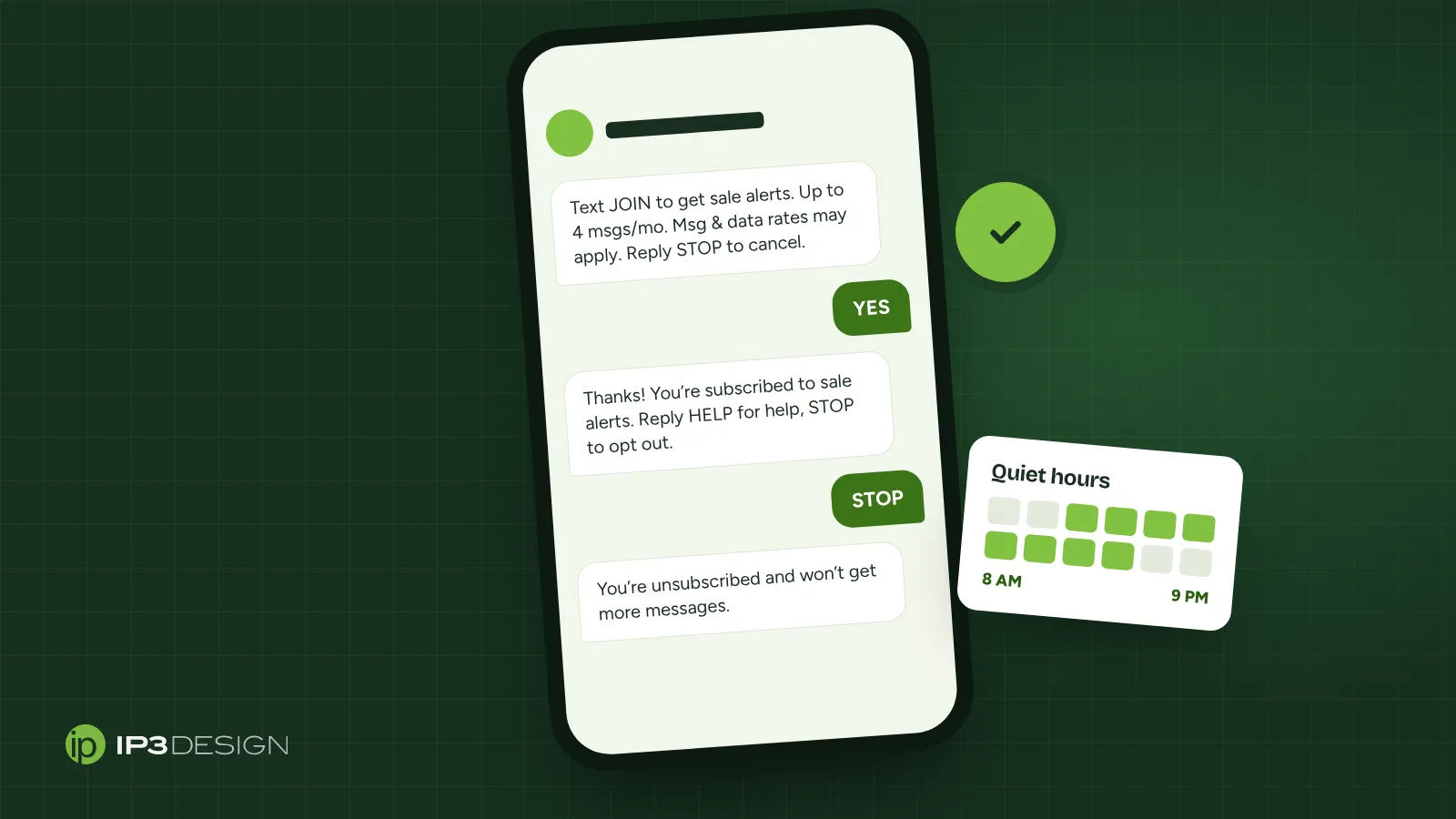
Once someone signs up, send a confirmation text right away that repeats who you are, what they’ll receive, the frequency, and how to opt out. Many platforms use a double opt-in, where the person replies YES to confirm. That extra step costs you a few signups but gives you a much stronger consent record.
Register before you send
This is the step that surprises most small businesses.
Business texts sent from ordinary 10-digit phone numbers, known as 10DLC, must be registered with the carriers through The Campaign Registry before they’ll be reliably delivered. Registration covers your business details (your brand) and what you’ll be sending (your campaign), including sample messages and how people opt in.
Your texting platform handles the submission, but you’ll need to provide accurate information, and approval isn’t instant. Some platforms send from toll-free numbers instead, which go through a separate verification. Klaviyo, for example, uses toll-free numbers by default in the US and says verification typically takes 2 to 5 business days, while 10DLC registration on other platforms can take a week or more. Plan for that before you schedule your first campaign.
Unregistered messages may be filtered or blocked outright, so skipping this step usually just means your texts don’t arrive.
When you can send
Federal rules restrict telephone solicitations to between 8 a.m. and 9 p.m. in the recipient’s local time. If you have customers in other time zones, your platform should respect their time zone, not yours.
The legal window isn’t the same as a good window, though. Most businesses get better responses texting during normal daytime hours, and a promotional text at 8:05 on a Sunday morning rarely wins anyone over.
Frequency matters too. Stick to what your signup promised. If you said “up to 4 messages a month,” don’t send 10 during a holiday sale.
Make opting out easy, and honor it fast
Your messages should include clear opt-out instructions, especially early on and periodically after that. “Reply STOP to opt out” is the standard, and carriers expect STOP, along with common variations like UNSUBSCRIBE, CANCEL and END, to work automatically.
The FCC’s rules also say people can revoke consent by any reasonable method. That includes replying in plain words like “please stop texting me,” telling a staff member, or sending an email. The rule requires businesses to honor these requests within 10 business days, and practically you should stop as soon as you can.
That has a few practical consequences:
- Train your team. If a customer at the counter says “take me off your texts,” someone needs to know how to do that.
- Watch replies. Read the replies to your campaigns and remove anyone who clearly wants out, even if they didn’t type the exact keyword.
- Send one confirmation. A single message confirming they’ve been unsubscribed is standard. Don’t follow it with “Are you sure?” or a last offer.
Message content that works
Once your setup is solid, the content is where SMS earns its place.
Keep it short and specific
A good marketing text is usually one or two sentences: who it’s from, what’s on offer, and one link or instruction. “Maple Street Coffee: Double punches on your loyalty card this Saturday only. Show this text at the counter. Reply STOP to opt out.” is easier to act on than a paragraph.
Identify yourself every time
Start each message with your business name. People rarely save business numbers, and a text with no clear sender looks like spam.
Use links you control
Link to your own website rather than generic link shorteners, which carriers often associate with spam. Many texting platforms offer branded short links.
Give people a reason to stay subscribed
The businesses that get the most from SMS treat it as a privilege. Send things people actually want: early access, real discounts, back-in-stock alerts, reminders they asked for. If every text is a generic “Shop now,” your opt-out rate will tell you.
Healthcare and other sensitive businesses
Medical, dental and other healthcare practices need extra care with texting. Appointment reminders are common and useful, but messages that involve patient information bring in privacy obligations beyond the TCPA, and some platforms aren’t set up to support them. A text that reveals a condition or treatment to whoever picks up the phone can be a privacy problem.
If you’re a healthcare provider, use a platform appropriate for patient communications, keep reminder texts minimal, and keep any marketing texts entirely separate from patient care messages. Our medical marketing page covers how we approach this for practices.
How SMS fits with email
SMS and email work best together. Email suits longer content: newsletters, guides, product stories, detailed offers. SMS suits short, time-sensitive messages people should see right away.
Many businesses use email as the main channel and save SMS for a few high-value moments: a flash sale, an event reminder, a back-in-stock alert. That keeps texts welcome rather than wearing.
Email has its own rules and its own deliverability challenges, which we covered in Why Your Marketing Emails Go to Spam. Our email and SMS marketing service sets up both channels so they support each other.
The mistakes that cause the most trouble
Most SMS problems for small businesses come from a short list of habits that seem harmless at the time.
Importing an old customer list. A spreadsheet of phone numbers from years of sales feels like an asset. Without marketing consent on record for each number, it’s a liability. Invite those customers to join instead, through email, a sign at the counter or a note on receipts, and let them opt in.
Texting from a personal phone. Sending promotions from the owner’s cell phone skips registration, consent records and automatic opt-outs all at once. It also tends to get the number flagged by carriers. Use a proper platform even for small lists.
Sharing one list across businesses. If you run two businesses, or partner with another one for an event, each business needs its own consent. People who signed up for your bakery’s texts didn’t agree to hear from your friend’s gym.
Forgetting the opt-out keyword after the first message. People forget how to stop messages. Including “Reply STOP to opt out” regularly costs a few characters and saves complaints.
Letting a contest create a list. A giveaway that requires entrants to text a keyword can be a good way to grow a list, but the entry still needs the same clear disclosures. “Text WIN to enter” with no mention of ongoing marketing messages doesn’t give you permission to send them.
A checklist before your first campaign
- Choose a reputable texting platform that handles 10DLC registration, consent records and automatic opt-outs.
- Write a clear signup with your business name, message type, frequency, rates, STOP and HELP instructions, and links to your terms and privacy policy.
- Collect consent properly. No pre-checked boxes, no purchased lists, no texting numbers collected for other purposes.
- Send a confirmation message to every new subscriber, ideally with a double opt-in.
- Register your brand and campaign and wait for approval before sending.
- Schedule messages within allowed hours in each recipient’s time zone.
- Train your team to handle opt-out requests made in person, by email or in plain-language replies.
- Keep records of every signup and opt-out.
Common questions
Can I text customers who gave me their number at checkout?
Not for marketing, unless they also gave written consent to receive marketing texts. A number collected for a receipt, an order or an appointment doesn’t cover promotions.
Do I need to register if I’m only sending a few texts?
If you’re sending business texts from a standard 10-digit number through a texting platform, expect to register. Your platform will tell you what’s required for your account.
What happens if someone replies “stop texting me” instead of STOP?
Treat it as an opt-out. The FCC’s rules allow people to revoke consent by any reasonable means, so remove them and don’t text them marketing messages again.
Where we come in
We set up SMS programs for small businesses that follow the rules from the first message: proper signup flows, registration, consent records and campaigns people are glad to receive. If you’d like help adding texting to your marketing, book a free consultation and we’ll walk through what makes sense for your business.